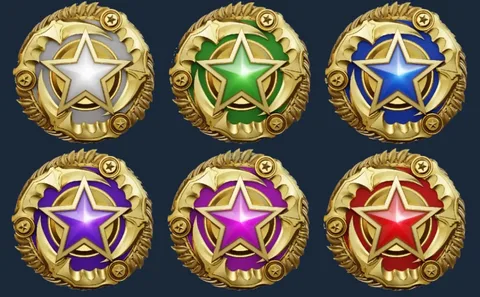
A lot of players want to know how to get a Service Medal in CS2 in 2026 — and the answer is straightforward: reach profile rank 40 (Global General) on official Valve servers and hit the rank reset button, after which the medal automatically drops into your inventory. The 2026 Service Medal is available from January 1 through December 31, 2026 — confirmed by Valve's official Steam announcement on December 26, 2025. Behind the simple mechanic lies a serious grind: six color tiers from gray to red, each one requiring another full rank reset from scratch.
What Is the CS2 Season Medal and Why Does It Matter?
The CS2 Service Medal is a cosmetic badge displayed next to your name in the lobby and on the scoreboard in matches. It has zero effect on your CS Rating, skill group, or Prime status — it's purely a visual marker of how much time you've put into CS2 over the current year. That complete absence of shortcuts is exactly what gives it its value: no case opening will get you one, the Steam Market won't help — it's earned through nothing but honest playtime.
Any game owner can get the CS2 Service Medal for free with no additional purchases required. The system has existed since 2015, when CS:GO introduced the first two tiers; 2016 expanded it to seven, and from 2018 onward it settled at six tiers — the same structure that carried over into CS2. The design changes every year: the 2026 medal features a gold color scheme with a purple star at the center and weapon motifs, evoking the legendary Pick'Em Trophy from Cologne 2014.
The system's defining feature is its hard deadline. After December 31, the chance to earn that season's medal is gone forever. Past-year medals can't be bought, traded, or awarded retroactively — they belong to whoever was grinding during the right year.
How to Get a CS2 Service Medal: Step-by-Step
The process is identical for every tier and hasn't changed from year to year. Before getting into the steps, there's one critical thing to understand: XP only counts on official Valve servers. Community servers, workshop maps, and custom lobbies give zero profile progress — this is an intentional design decision to ensure the medal reflects real playtime. Another iron rule: don't leave matches early. An early exit wipes all XP earned during that session.
Here's the full sequence that puts that badge in your inventory:
Launch CS2 through the official Steam client.
Play exclusively on official Valve servers (Competitive, Premier, Wingman, Casual, Deathmatch, Arms Race).
Earn 200,000 XP — that's 40 profile levels at 5,000 XP each.
Once you hit Global General (Rank 40), a "Get Service Medal" button will appear above your XP bar.
Confirm the reset: your profile rank drops back to Private Rank 1, and the medal lands in your inventory.
To display it on your profile: Inventory → Display tab → "Display This Item."
It's important to know that resetting your profile rank has no effect whatsoever on your CS Rating in Premier or your skill group in Competitive — those are entirely separate systems. The easiest way to get at least the gray-tier medal in CS2 is to start grinding in January and play a few consistent hours per week rather than leaving everything to December. Each additional reset within the same calendar year upgrades the medal's color to the next tier.
CS2 Medal Colors and Tiers in 2026
Color is the only visual indicator of how many resets you've completed. Progression is strictly linear: you can't skip a tier, every cycle has to be done honestly from the bottom. The black medal (7th tier) that existed in CS:GO was removed back then — it required an unrealistic number of resets and could never be obtained legitimately.
Once you understand how the different CS2 medal tiers work, it becomes clear: this isn't about how well you play, it's about time and consistency. The purple tier (level 4) is a realistic goal for someone putting in 6–8 hours a week throughout the year. The key to reaching any tier at all is starting on day one of January and avoiding long breaks — every week you skip is bonus XP you'll never get back. The red medal is a whole different conversation, covered below.
How to Farm the CS2 Medal Faster: Game Mode XP Breakdown
Grind speed depends directly on which mode you play and how well you understand the XP formulas. Players looking to hit the medal as fast as possible often assume Competitive is the only real option. In reality each mode has its own logic: Competitive and Premier award XP for rounds won (30 XP per round), making them dependent on teammates and opponents; Deathmatch rewards individual performance (0.2 XP × score), delivering consistent results regardless of how anyone else is playing.
For solo players, Deathmatch is the most reliable option: matches run exactly 10 minutes and your XP depends entirely on your own shooting. Competitive and Premier make sense when you have a solid stack with a healthy win rate. Wingman is the sweet spot for duos — matches are short and individual impact on the outcome is at its highest. Mixing modes isn't just acceptable, it's smart — it cuts down on the mental fatigue of monotonous grinding.
How the Weekly XP Bonus Works and When to Play
Understanding the bonus XP system is key to grinding the 2026 CS2 medal more efficiently. Every week Valve provides a pool of 5,000 bonus XP: the first 3,500 XP from that pool come with a ×3 multiplier, and the remaining 1,500 XP scale down gradually to ×1. The pool resets every Tuesday/Wednesday at 00:00 UTC. Once the bonus is exhausted, XP keeps accumulating — just significantly slower.
The practical strategy: your most valuable sessions are at the start of the week, right after the reset. That's when your first few Deathmatch or Competitive matches pay out three times the normal rate. Players who burn through the full bonus in 3–4 hours on Tuesday or Wednesday can comfortably take a break until the next week — grinding without the multiplier is considerably less efficient. If the bonus is used up and an XP Overload icon appears next to your name, that's just a visual indicator of activity, not a penalty.
The takeaway: you can earn the CS2 medal at any pace, but players aiming for purple tier or higher will save 20–30% of their time simply by scheduling their main sessions at the start of each week.
Is the Red CS2 Medal Realistically Achievable in One Year?
This is the question on every player's mind when they start thinking about stacking medals in a single season. The honest answer: technically possible, practically only for hardcore grinders. Let's do the math. The red medal requires 1,200,000 XP. The weekly bonus contributes 5,000 XP × 52 weeks = 260,000 XP. The remaining ~940,000 XP has to come from regular matches.
At roughly 10 hours per week in Competitive with a decent win rate, you can realistically earn around 500,000–620,000 XP per year on top of bonuses. That puts a player at that pace somewhere around tier 4 (purple) by year's end — which is already a serious achievement. The red medal demands 15–20 hours a week sustained across the entire year. That's exactly why it commands instant respect in the lobby without a word: everyone can do the math on what it takes.
What Other Medals and Coins Exist in CS2?

The Service Medal isn't the only badge you can show off on your profile. CS2 has several categories of collectible items with different unlock conditions. Some are awarded automatically with no purchases required; others belong to the past and can never be obtained again.
Here are the main profile reward types players encounter most often:
The CS2 Veteran Medal — this is the 10 Year Veteran Coin, awarded automatically when a Steam account with any version of CS has existed for 10 or more years. You can check your purchase date in Steam settings (Library section). No action required — the coin appears on its own when the time comes.
The CS2 Major Medal — this refers to the Event Coin tied to a specific tournament. To get one, you need to purchase a Viewer Pass from the Steam store during an active Major and participate in the Pick'Em Challenge. The coin upgrades from Bronze to Diamond based on the accuracy of your predictions. The most recent available pass was the Budapest 2025 Viewer Pass (November 2025); Valve has not officially announced the date for the next 2026 Major.
The CS2 Map Medal — this is the Contributor Coin, awarded exclusively to creators of maps included in official CS2 operations. It's simply not available to regular players.
The Loyalty Badge and Global Offensive Badge are awarded automatically when launching CS2, provided the player owned CS:GO before December 6, 2018, and played it before September 27, 2023, respectively. New accounts have no way to obtain these.
It's worth understanding what separates these rewards. The Service Medal refreshes every year and is open to everyone. The Event Coin is tied to a specific Major and requires purchasing a pass. The legacy badges (Loyalty Badge, Global Offensive Badge) are artifacts of the past that simply signal a player's veteran status. The Service Medal is the only reward in CS2 you can add to your collection annually with no extra spending.
The Medal Is the Best Way to Leave a Mark on Your Profile
The bottom line is simple: getting a CS2 Service Medal doesn't require you to be a pro or spend a dime — just official Valve servers, 200,000 XP, and one button press. The only thing to keep in mind is the December 31, 2026 deadline, after which that season's medal is gone forever. The earlier you start grinding, the better your chances of reaching green or blue tier instead of scrambling for a gray one in December. The 2026 medal with its gold design is the kind of inventory item that only gets more meaningful over time.